ManjuLAB · Whitepaper
EDEN SUTRA
The Garden of Knowledge — walk the path from a single seed to an endless forest. Every glowing orb is a chapter; tap one to open it.

By Yogabrata Mukhopadhyay · ManjuLAB — all visuals watermarked & copyrighted.
Prologue
Welcome to the Garden of Knowledge
Eden Sutra · Overview — the philosophy behind the journey
Yogabrata Mukhopadhyay · 8 min read
Empty Field → First Light

© Yogabrata Mukhopadhyay · ManjuLAB. All rights reserved.
Every forest of understanding begins in an empty field, with a single spark of life.
Before the journey begins
Eden Sutra begins with a simple premise: education is not a stack of chapters, but a living map of connected ideas.
Three Living Guides walk beside you through this whitepaper: Carbon — The Guide to Matter; Amino — The Guide to Life Formation; and near the journey's end, Curiosity — The Guide to Discovery. They are not mascots. They are elegant Knowledge Companions whose reflections reveal how one concept in the Garden connects to the physical world and to life itself.
Education is more than preparing for an examination. It is the practice of understanding the world, discovering patterns, asking meaningful questions, and connecting ideas that first appear unrelated.
Modern learning often separates knowledge into subjects, books, chapters, and tests. Students may master individual topics while missing how one idea depends on another. Eden Sutra was created to restore that missing context.
Inspired by Brahmando, Eden Sutra views every concept as part of a larger picture. Mathematics speaks to physics. Chemistry explains biology. History shapes science. Technology transforms every discipline. The deeper the connections, the deeper the understanding.
EDEN — Garden of Knowledge
Every tree bears a different kind of knowledge. Some fruits are familiar; others wait to be discovered. The invitation is simple: explore freely, learn fearlessly, and nourish curiosity.
Eden Sutra moves beyond bookish knowledge toward holistic learning. Every concept has a purpose, every idea has a story, and every lesson becomes more meaningful when seen through nature, daily life, innovation, and human civilization.
One guiding principle is to bridge the gaps in understanding. Human progress has always come from asking one more question, making one more observation, and discovering one more connection.
Behind the philosophy is a modern knowledge architecture. Concepts are represented as interconnected knowledge structures, enriched by artificial intelligence, so relationships can be discovered and learning can grow as a living ecosystem.
This white paper presents the philosophy, architecture, and vision behind Eden Sutra. The journey begins with a single concept. It never truly ends.
Appendix
Knowledge Anchors
Eden Sutra · Teaching concepts through reality and lived examples
Yogabrata Mukhopadhyay · 5 min read
Wisdom stabilized, knowledge embodied
Every concept should answer what it is, why it exists, what problem it solved, where it appears, which industries use it, how experts think about it, and why the student should care.
- Anchor Object
- One-Line Hook
- Real-World Analogy
- Historical Story
- Famous Real Example
- Industries That Use It
- Student Question to Ponder
Eden Sutra — Volume I
Knowledge Atom
The Seed Before Planting
Yogabrata Mukhopadhyay - 12 min read
Garden Journey · Empty Garden → Seed

© Yogabrata Mukhopadhyay · ManjuLAB. All rights reserved.
In the beginning, the garden is empty — not because nothing exists, but because nothing has yet been named. Every forest was once a single seed held in silence.
Eden Sutra · Prologue to the Garden
Before a learner opens a textbook, before a teacher writes a lesson plan, before an examination is set — there is a moment of pure possibility. A concept waits, unnamed, unconnected, yet complete in potential. In Eden Sutra, we call this moment the Knowledge Atom: the seed before planting.
Education is more than preparing for an examination. It is the practice of understanding the world, discovering patterns, asking meaningful questions, and connecting ideas that first appear unrelated. Modern learning often separates knowledge into subjects, books, chapters, and tests. Students may master individual topics while missing how one idea depends on another. Eden Sutra was created to restore that missing context — beginning with the smallest unit that can still carry meaning: the atom.
ManjuLAB is the first implementation of this philosophy. The philosophy itself belongs to the Garden.
The Knowledge Representation Crisis
Data, information, and knowledge are often conflated. Data are raw symbols. Information is data placed in context. Knowledge is information that supports inference, prediction, and action under constraint. Large language models excel at information transformation but lack an explicit knowledge layer; they approximate structure statistically rather than representing it declaratively.
In education, healthcare, telecommunications, and enterprise operations, this gap manifests as syllabus drift, hallucinated facts, inconsistent terminology, and inability to explain why a particular output is valid. Sustainable intelligence — human or machine — requires a representation that both can share: a graph of atoms, not a bag of tokens.
Formal Definition: Knowledge Atom
A Knowledge Atom A is a tuple:
A = (id, name, domain, definition, parents, children, relations, misconceptions, assessments, media, version)
- id — deterministic, globally unique identifier (Universal Concept Identity)
- name — canonical label plus aliases across languages
- domain — subject or industry scope (for example: biology, finance, law)
- definition — normative statement of meaning, with formulae where applicable
- parents / children — directed prerequisite and composition edges
- relations — typed links: is-a, part-of, governed-by, evaluated-by
- misconceptions — documented learner or model errors tied to the atom
- assessments — exercise templates, Bloom levels, competency mappings
- version — semantic version string; atoms are immutable, updates fork new versions
© Yogabrata Mukhopadhyay · ManjuLAB. All rights reserved.
Knowledge DNA
Knowledge DNA is the complete encoded payload of an atom: everything required to teach, assess, and reason about a concept without consulting external prose. The metaphor is intentional. Just as biological DNA specifies organism traits, Knowledge DNA specifies conceptual traits across deployments.
Immutability is a design principle. When a curriculum board revises a definition, Eden Sutra does not overwrite the atom; it publishes A' with a new version and maintains lineage edges. Downstream graphs, assessments, and agent policies reference explicit versions, preserving reproducibility for accreditation, litigation, and research audit.
© Yogabrata Mukhopadhyay · ManjuLAB. All rights reserved.
From Atoms to Graphs
Knowledge Atoms are vertices in a deterministic knowledge graph G = (V, E). Edges carry types and optional weights such as prerequisite strength or similarity score. Graphs are built from curriculum plugins, ontologies, and ingestion pipelines — not by emergent clustering of embeddings alone.
This enables prerequisite-aware traversal, coverage analysis against syllabus boundaries, gap detection when learning objectives lack supporting atoms, and explainability, where every generated artifact cites the atom IDs that justified it.
© Yogabrata Mukhopadhyay · ManjuLAB. All rights reserved.
Limitations and Future Work
Atom modeling requires upfront ontology effort. Low-resource domains may lack curated definitions; hybrid human-in-the-loop authoring remains necessary. Multilingual atoms demand terminology governance beyond direct translation.
Future work includes automated atom extraction from corpora with human validation gates, cross-domain alignment mapping atoms between curricula and industry competency frameworks, and integration with embedding indexes for hybrid retrieval: graph-first, vector-assisted.
Eden Sutra — Volume II
Connections Beneath Understanding
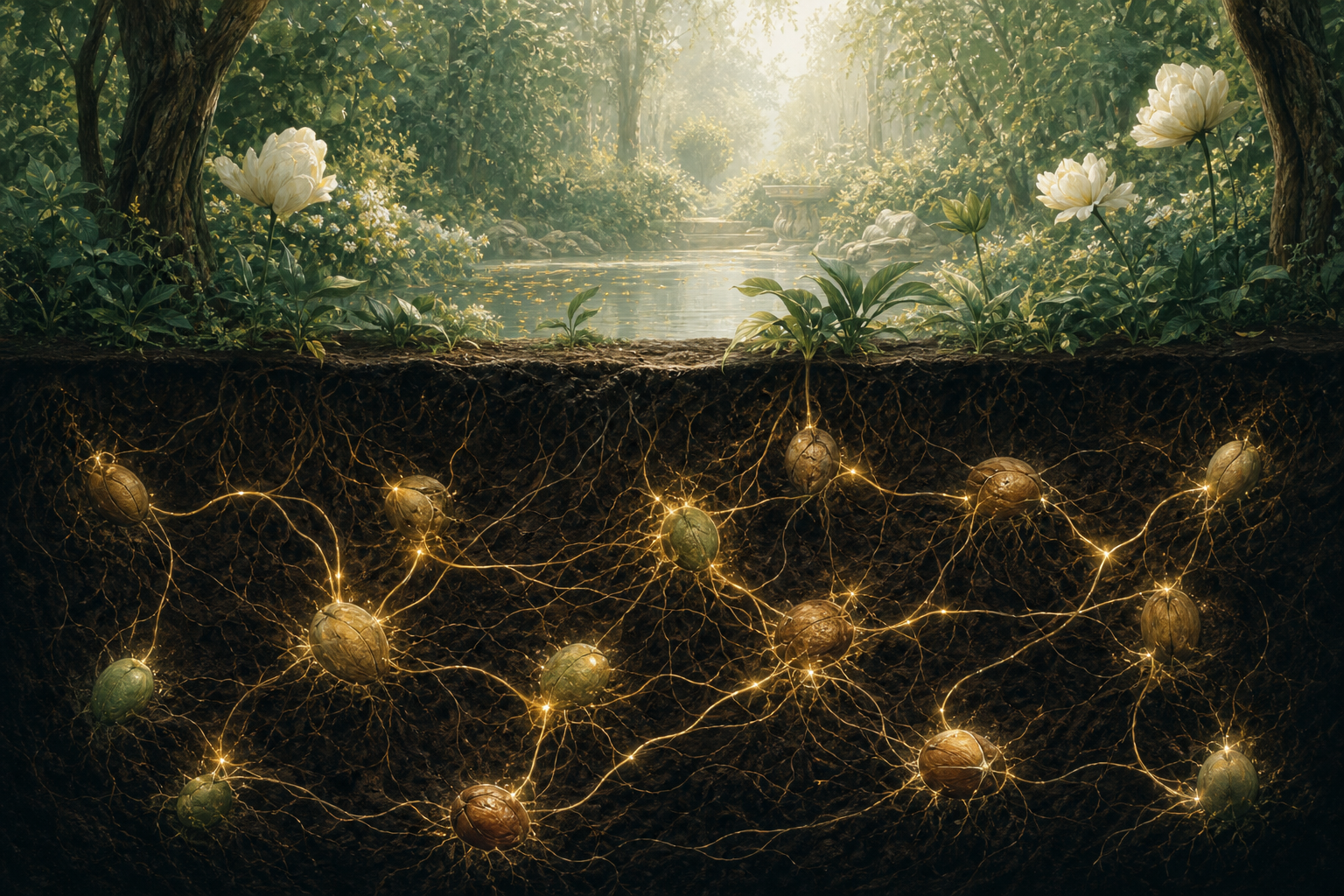
Roots Under the Soil
Yogabrata Mukhopadhyay - 11 min read
Garden Journey · Roots
© Yogabrata Mukhopadhyay · ManjuLAB. All rights reserved.
What the eye sees is leaf and flower. What the mind must learn is root — the hidden architecture that holds the visible world upright.
Eden Sutra · On Connection
A seed has been placed in soil. For days, perhaps weeks, nothing appears above the surface. The learner grows impatient. The teacher wonders if the lesson failed. Yet beneath the earth, something essential is happening: roots extend, anchor, and search — forming a network long before the first sprout breaks daylight.
Understanding follows the same rhythm. A student may recite a definition without grasping why it matters. Another may struggle with a problem while quietly assembling prerequisites that will, in time, make the solution inevitable. In Eden Sutra, these invisible connections are not accidents. They are roots — typed edges in a deterministic knowledge graph that give every atom its place in the living soil of meaning.
Understanding Beneath the Surface
Real understanding often begins invisibly. Connections form beneath the surface before confidence appears. Students who "suddenly get it" have usually been assembling prerequisites for weeks — through practice, partial failures, and quiet pattern recognition.
Eden Sutra treats these connections as first-class objects. A Knowledge Atom without edges is incomplete data. Parents, children, and typed relations are not optional metadata; they are how the Garden knows which seeds can grow beside which others.
Deterministic Knowledge Graphs
Knowledge Atoms are vertices in a graph G = (V, E). Edges carry types and optional weights: prerequisite strength, similarity score, governance, evaluation. Graphs are built from curriculum plugins, ontologies, and validated ingestion — not by emergent clustering of embeddings alone.
This enables: prerequisite-aware traversal; coverage analysis against syllabus boundaries; gap detection when learning objectives lack supporting atoms; and explainability, where every generated artifact cites the atom IDs that justified it.
© Yogabrata Mukhopadhyay · ManjuLAB. All rights reserved.
Policy-Guided Traversal
Traversal is not free-form graph wandering. It is policy-guided navigation. Rules specify which edge types agents and learners may follow, maximum depth, required atom types for certain operations, and cross-domain bridges — mapping physics concepts to engineering applications without merging incompatible definitions.
Multi-domain graphs federate namespaces while preserving local ontologies. A telecommunications fault-diagnosis graph and a secondary-school physics graph may share upper-level mathematical atoms without collapsing distinct definitions.
© Yogabrata Mukhopadhyay · ManjuLAB. All rights reserved.
Roots and Explainability
When a tutor recommends a remediation path, an examiner validates a question, or an agent drafts a lesson, Eden Sutra expects a trace: which atoms were traversed, which prerequisites were satisfied or missing, which misconceptions were addressed. Roots are not only pedagogical; they are ethical. Accountability grows from what lies beneath.
Eden Sutra — Volume III
EDEN Sutra
First Sprout
Yogabrata Mukhopadhyay - 11 min read
Garden Journey · First Sprout

© Yogabrata Mukhopadhyay · ManjuLAB. All rights reserved.
The sprout does not argue with the soil. It simply turns toward the light — and in doing so, reveals the shape of what was always waiting to grow.
Eden Sutra · On Emergence
After roots have searched and anchored, the Garden grants the learner a first visible reward: a sprout. Two leaves, impossibly tender, reach toward morning. Above the soil, understanding becomes showable — to the student, the teacher, and the world.
EDEN Sutra names this moment the organizing principle of holistic learning. Not a stack of chapters to memorize, but a living method: every concept presented with clarity, anchored in analogy, connected across disciplines, and resolved in insight. The sprout is not the forest — but it is proof that the seed was true.
Inspired by Brahmando, Eden Sutra views every concept as part of a larger picture. Mathematics speaks to physics. Chemistry explains biology. History shapes science. Technology transforms every discipline. The deeper the connections, the deeper the understanding.
The EDEN Method: Concept, Analogy, Connection, Insight
Every concept taught through Eden Sutra answers four questions in sequence:
- Concept — What is it, precisely and canonically?
- Analogy — What familiar experience makes it approachable?
- Connection — Which other atoms does it require, enable, or resemble?
- Insight — Why does it matter to the learner, to science, to civilization?
This is not a template for busywork. It is the minimum structure for a sprout to survive transplantation — from classroom to examination to life beyond school.
Knowledge Anchors
Every concept should answer what it is, why it exists, what problem it solved, where it appears, which industries use it, how experts think about it, and why the student should care. Eden Sutra stabilizes this through Knowledge Anchors:
- Anchor Object — a concrete real-world referent
- One-Line Hook — the memorable entry point
- Real-World Analogy — the cotyledon leaf
- Historical Story — how humanity discovered it
- Famous Real Example — where experts point
- Industries That Use It — where it lives in work
- Student Question to Ponder — the root sent downward
Curriculum as Graph Projection
Each curriculum plugin specifies subjects and grade levels, chapter hierarchies, grading policies, supported languages, and learning outcomes with prerequisite rules. Adding CBSE Grade 10 Science, ICSE Mathematics, or a corporate compliance program requires a new plugin — not a platform fork.
Let G be the universal atom graph and P a curriculum plugin. The projected curriculum graph GP = π(G, P) includes only atoms and edges licensed by P, with additional policy nodes. Coverage analysis becomes a graph question: which learning objectives lack supporting atoms? Which prerequisites form cycles or gaps?
© Yogabrata Mukhopadhyay · ManjuLAB. All rights reserved.
Beyond Bookish Knowledge
Eden Sutra moves beyond bookish knowledge toward holistic learning. Every concept has a purpose, every idea has a story, and every lesson becomes more meaningful when seen through nature, daily life, innovation, and human civilization.
One guiding principle is to bridge the gaps in understanding. Human progress has always come from asking one more question, making one more observation, and discovering one more connection. Behind the philosophy is a modern knowledge architecture — concepts as interconnected structures, enriched so relationships can be discovered and learning can grow as a living ecosystem.
This whitepaper presents the philosophy, architecture, and vision behind Eden Sutra. The journey begins with a single concept. It never truly ends.
Eden Sutra — Volume IV
Gamma Core
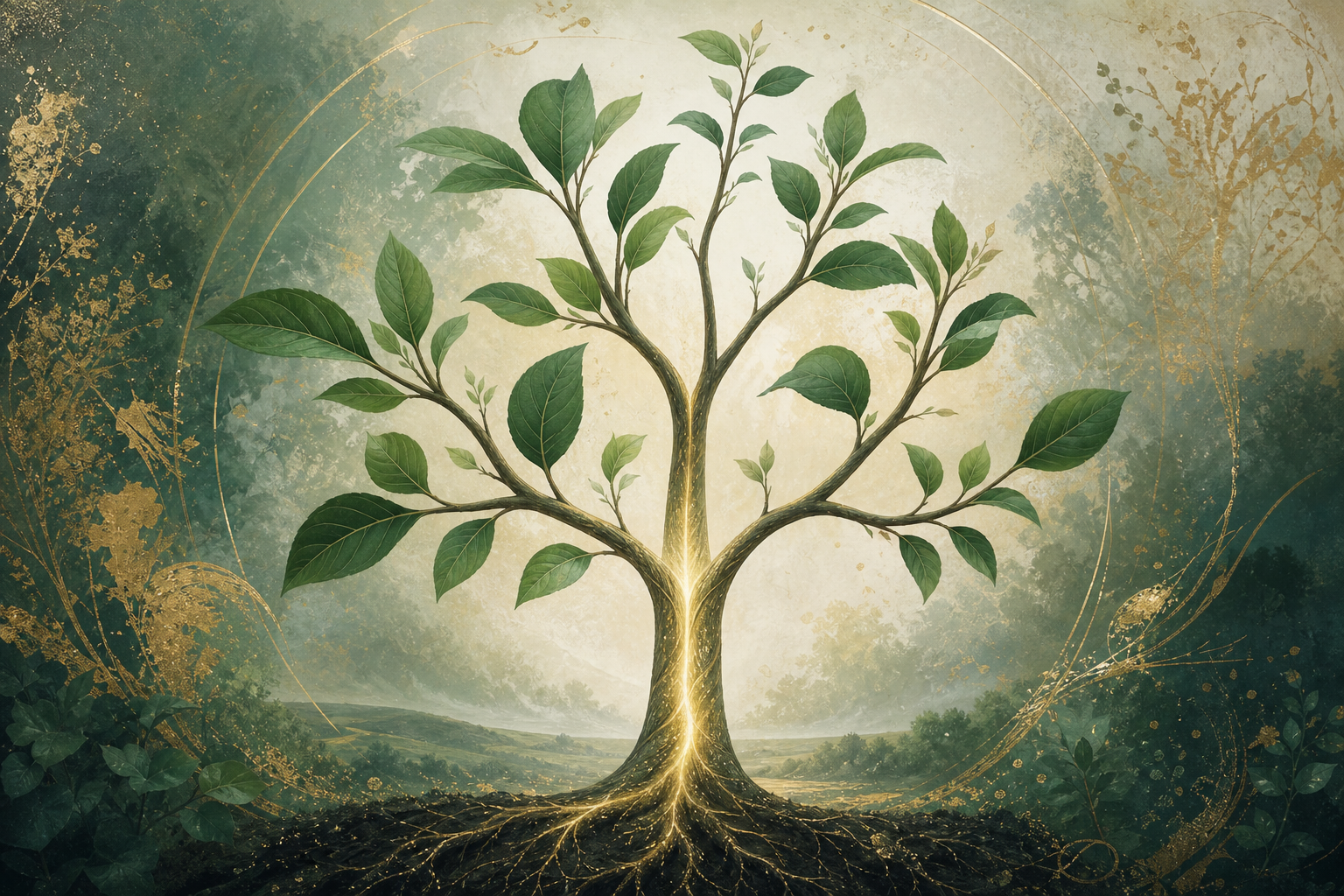
Young Tree with Branch Logic
Yogabrata Mukhopadhyay - 10 min read
Garden Journey · Young Tree with Branch Logic
© Yogabrata Mukhopadhyay · ManjuLAB. All rights reserved.
A tree does not grow every branch it could. It grows the branches it must — each reaching for light the others cannot.
Eden Sutra · On Structure
The sprout has survived. Now it must decide what kind of plant it will become. A young tree faces a quiet engineering problem: how to carry water and meaning from a single root system out to leaves that may be metres apart, without collapsing under its own ambition. The answer is architecture — a trunk that stays whole while branches specialise.
Eden Sutra calls this stage the Gamma Core: the Semantic Operating System that lets one body of knowledge grow many disciplined branches without losing its integrity. Where earlier chapters described the atom and its connections, Gamma Core describes the runtime — the living wood through which every atom, graph, agent, and learner is managed as a first-class citizen.
An operating system does for a computer what the trunk does for a tree: it decides which processes run, which memory is protected, which devices may be touched. The Gamma Core does the same for knowledge, so that a curriculum, a tutor, and an enterprise deployment can share one substrate and still keep their own shape.
The Semantic Operating System
A Semantic Operating System (SOS) is the runtime that manages Knowledge Atoms, graphs, agents, and human interfaces as first-class resources — analogous to how a conventional operating system manages processes, files, and devices. Where a traditional OS schedules CPU time, the SOS schedules reasoning: which atoms are loaded, which traversals are permitted, which agents may act, and which results are published.
This is the difference between a folder of documents and a living institution. A folder stores; an operating system governs. Gamma Core governs knowledge so that the same trunk can support a school, a research group, and an enterprise without any of them corrupting the others.
OS Layers
The Gamma Core is organised as a stack of cooperating layers, each with a single responsibility:
- Atom Store — immutable, versioned repository with lineage and access control
- Graph Engine — traversal, query, coverage analysis, and consistency checks
- Plugin Registry — curriculum and domain namespaces
- Agent Runtime — orchestration, scheduling, and tool sandboxing
- Publication Bus — validated artifact distribution to learning systems, apps, and APIs
- Observability — audit logs, provenance traces, and policy enforcement
Each layer can evolve independently, but all draw from the same versioned Atom Store — the trunk that keeps the branches honest.
© Yogabrata Mukhopadhyay · ManjuLAB. All rights reserved.
Traversal Rules and Multi-Domain Graphs
Traversal is policy-guided navigation. Rules specify which edge types agents may follow, maximum depth, required atom types for certain operations, and cross-domain bridges — such as mapping physics concepts to their engineering applications.
Multi-domain graphs federate namespaces while preserving local ontologies. A telecom fault-diagnosis graph and a school physics graph may share upper-level mathematical atoms without merging incompatible definitions. The trunk is shared; the branches keep their own leaves.
© Yogabrata Mukhopadhyay · ManjuLAB. All rights reserved.
Enterprise and Research Deployment
Enterprises deploy SOS instances with private atom stores, single sign-on integration, and data-residency controls. Research institutions use the same stack for reproducible experiment graphs, where every paper, dataset link, and method atom is versioned for citation.
MANJULAB is the first implementation of this architecture; the architecture itself belongs to the Garden. Compute for graph ingestion, embedding indexes, and agent workloads can run on-premise, in a regional cloud, or across hybrid topologies — the Gamma Core abstracts where the wood happens to grow.
Eden Sutra — Volume V
Interdisciplinary Learning
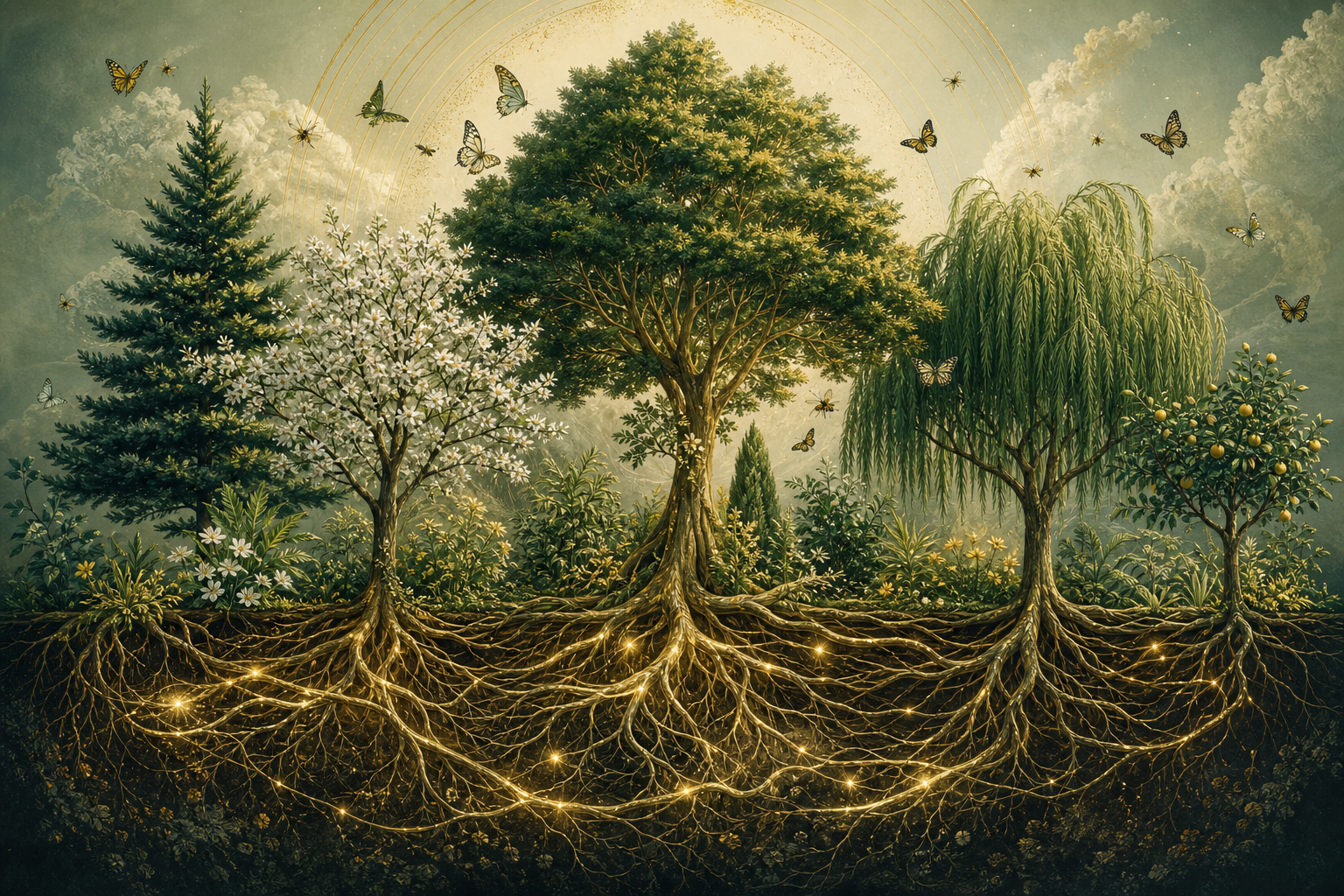
Garden Ecosystem Begins
Yogabrata Mukhopadhyay - 10 min read
Garden Journey · Garden Ecosystem Begins
© Yogabrata Mukhopadhyay · ManjuLAB. All rights reserved.
A forest is not many trees standing near each other. It is one conversation held in a thousand voices, beneath the soil where no one is watching.
Eden Sutra · On Ecosystems
A single tree, however well-branched, is still a specimen. Life becomes an ecosystem only when organisms begin to depend on one another — when the fungus feeds the root, the bee carries the pollen, the fallen leaf becomes next season's soil. In the Garden of Knowledge, this is the moment subjects stop being separate.
Eden Sutra was built to restore a missing context: mathematics speaks to physics, chemistry explains biology, history shapes science, and technology transforms every discipline. Modern schooling often plants each subject in its own pot, on its own shelf, tested in isolation. Students master topics while missing how one idea depends on another. Interdisciplinary learning is the garden bed where the pots are finally emptied into shared soil.
The deeper the connections, the deeper the understanding. A learner who sees oxidation in chemistry, respiration in biology, rust on a bridge in engineering, and the browning of a cut apple at breakfast is not learning four facts — they are learning one truth wearing four coats.
Knowledge Pollination
In Eden Sutra, an interdisciplinary link is not a footnote — it is a typed edge in the knowledge graph, carrying a relationship such as analogous-to, applied-in, or prerequisite-for-across-domain. These edges let a concept mastered in one subject accelerate learning in another. A student who understands equilibrium in chemistry meets equilibrium in economics as a familiar face, not a stranger.
We call this knowledge pollination: the deliberate carrying of understanding from one grove to another. Where traditional curricula quarantine subjects, Eden Sutra treats the crossings as the most valuable paths in the graph.
Semantic Equivalence Across Domains
Cross-domain reasoning requires mapping atoms between ontologies: when is "oxidation" in chemistry equivalent to "electron loss" in physics instruction? Alignment functions map atom pairs with confidence scores and provenance. Human reviewers validate high-stakes equivalences; automated proposals accelerate low-risk links.
Equivalence edges enable transfer: a tutoring strategy validated for one misconception atom can propagate to aligned atoms in adjacent domains. The forest learns as a whole, not one tree at a time.
© Yogabrata Mukhopadhyay · ManjuLAB. All rights reserved.
Synthesis as the Goal
The purpose of interdisciplinary structure is not to blur subjects into mush, but to enable synthesis: the learner's ability to assemble ideas from many groves into a single, defensible understanding of a real problem. Climate, health, energy, and justice are not subjects — they are gardens that only an interdisciplinary mind can tend.
Eden Sutra measures success not by how many isolated facts a learner can recall, but by how gracefully they can walk between groves and bring back something whole.
Eden Sutra — Volume VI
AI as the Gardener's Companion
Intelligent Light Through the Garden
Yogabrata Mukhopadhyay - 10 min read
Garden Journey · Intelligent Light Through the Garden

© Yogabrata Mukhopadhyay · ManjuLAB. All rights reserved.
Light shows the gardener where the weeds hide and where the fruit has ripened. It never decides what the garden is for. That is the gardener's to keep.
Eden Sutra · On Companionship
A flourishing garden has shaded corners — relationships too deep, too tangled, or too numerous for any single gardener to see. For most of history, this was simply the limit of a human mind: a teacher could hold only so many connections at once. Then came a new kind of light.
Eden Sutra places artificial intelligence in the garden not as a replacement gardener but as intelligent light — moving between the trees, illuminating relationships that were always there, accelerating discovery without ever seizing the spade. AI helps reveal hidden connections; the learner decides which to cultivate. This is the difference between a companion and a master.
ManjuLAB builds this companion as an agentic layer: systems that can traverse the knowledge graph, propose links, draft explanations, and check their own work — always under guardrails, always leaving a trace a human can follow. The gardener remains responsible for the garden.
Agentic Knowledge Systems
An agent, in Eden Sutra, is a bounded reasoner that operates over the knowledge graph on behalf of a learner or institution. It can plan a traversal, retrieve supporting atoms, draft a lesson or an answer, and verify that draft against the graph before presenting it. Crucially, it is bounded: its permissions, depth, and toolset are declared in advance.
This is knowledge beyond boundaries in the safe sense — an agent can reach across domains the learner has not yet studied, bringing back relevant context — while remaining inside the boundaries of policy, provenance, and human oversight.
© Yogabrata Mukhopadhyay · ManjuLAB. All rights reserved.
Guardrails and Explainability
When a tutor recommends a remediation path, an examiner validates a question, or an agent drafts a lesson, Eden Sutra expects a trace: which atoms were traversed, which prerequisites were satisfied or missing, which sources justified each claim. Explainability is not decoration — it is the condition under which an institution may trust a machine at all.
Guardrails constrain what an agent may do; explainability records what it did. Together they turn a powerful generator into a trustworthy companion.
The Human Remains the Gardener
Eden Sutra's design principle is unambiguous: the learner and the educator hold final authority. AI proposes; humans dispose. An agent may surface a hundred candidate connections; the gardener chooses which enter the curriculum. This is not caution for its own sake — it is the recognition that meaning, purpose, and value are human questions that no amount of computation can answer on our behalf.
The measure of a good companion is not how much it does, but how much better the gardener becomes for its help.
Eden Sutra — Volume VII
Personalized Learning Paths
Different Paths Through the Same Garden
Yogabrata Mukhopadhyay - 9 min read
Garden Journey · Different Paths Through the Same Garden

© Yogabrata Mukhopadhyay · ManjuLAB. All rights reserved.
Two travellers reach the same clearing — one by the river, one by the ridge. The clearing was never in doubt. Only the walking was theirs to choose.
Eden Sutra · On Paths
Stand at the edge of a great garden and watch the visitors. One runs straight for the roses; another lingers at the pond; a third needs the gentle slope because the stairs are too steep today. They will all reach the central grove — but to insist they take identical steps would be to mistake the path for the destination.
Eden Sutra holds a quiet, radical position: the same knowledge garden can support many learner journeys, and personalization changes the route, not the truth. The Pythagorean theorem is the same for every student; what differs is the order, pace, analogy, and support each one needs to truly hold it.
Because knowledge is represented as a graph rather than a fixed sequence of chapters, a learner's path can be projected from where they are to where they must go — respecting prerequisites, honouring strengths, and repairing gaps — without ever changing the underlying facts of the garden.
Paths as Graph Projections
A learning path in Eden Sutra is a projection over the knowledge graph: a route from a learner's current mastery to a target competency that respects prerequisite edges and avoids gaps. Because the graph is shared, two learners pursuing the same goal may receive different routes while relying on identical, versioned atoms.
This separates the what from the how. The what — the concepts, their definitions, their relationships — is canonical and stable. The how — order, pace, analogy, and support — is personal and fluid.
© Yogabrata Mukhopadhyay · ManjuLAB. All rights reserved.
Mastery, Not Coverage
Traditional courses optimise for coverage: did we get through the syllabus? Eden Sutra optimises for mastery: does the learner truly hold each atom, with its prerequisites intact? A mastery model tracks which atoms are secure, which are shaky, and which misconceptions persist — and adjusts the path accordingly, looping back before moving on.
Assessment becomes diagnostic rather than merely summative. A wrong answer is not a verdict; it is a signal that reshapes the path.
The Same Truth for Everyone
A crucial guarantee sits beneath personalization: no learner receives a lesser truth. Personalization must never harden into low expectations for some and high for others. The garden's grove is the same for all; only the walking differs. Eden Sutra encodes this as an invariant — paths may vary in route and pace, never in the integrity of what is finally learned.
Eden Sutra — Volume VIII
Democratizing Intelligence
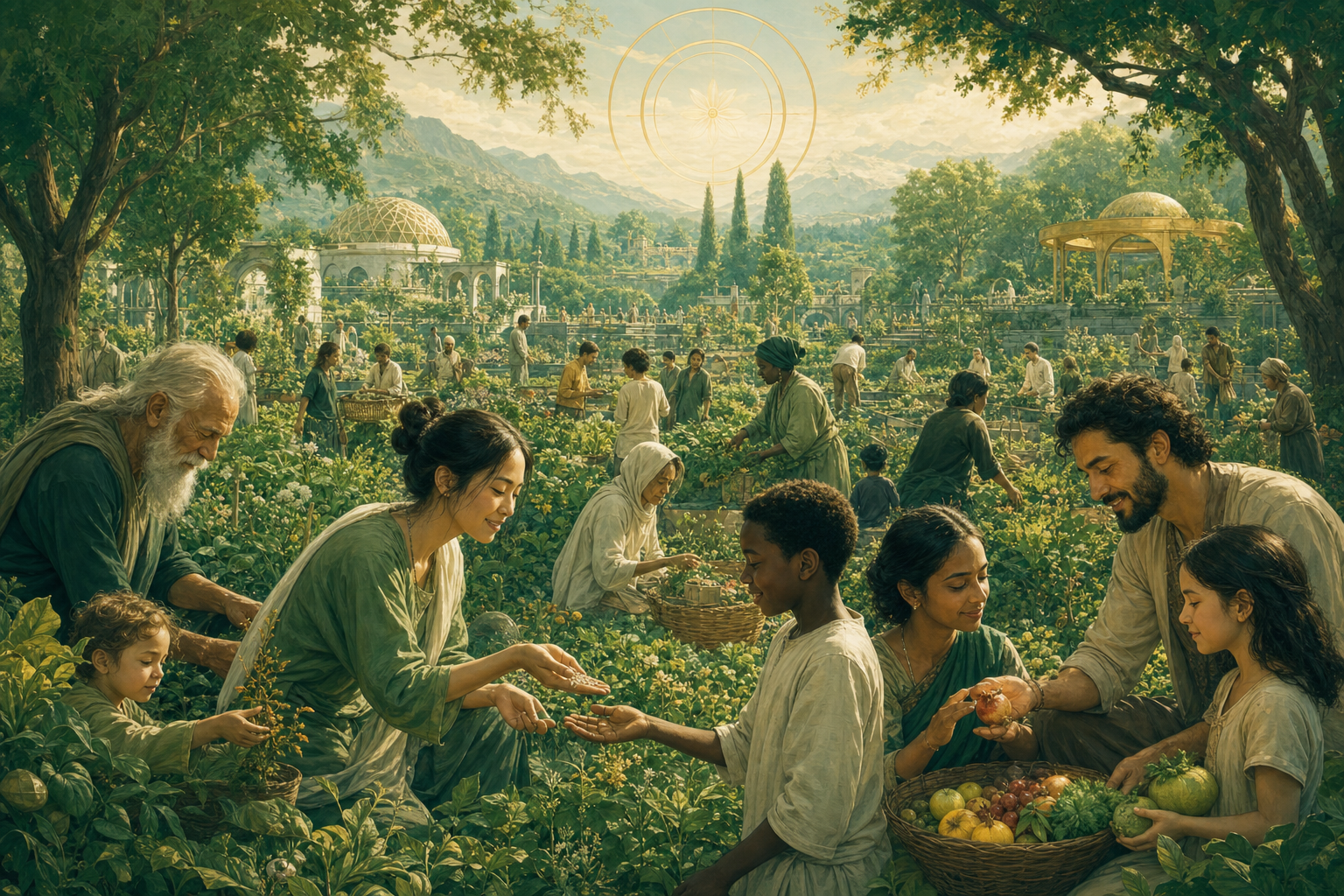
Shared Community Garden
Yogabrata Mukhopadhyay - 9 min read
Garden Journey · Shared Community Garden
© Yogabrata Mukhopadhyay · ManjuLAB. All rights reserved.
A seed kept in one hand feeds no one. A seed shared across a village becomes a harvest, and the harvest becomes more seed.
Eden Sutra · On the Commons
For most of history, the richest gardens were walled. Knowledge was hoarded — in monasteries, in guilds, in expensive institutions, behind languages and borders and fees. To learn deeply, one first had to be admitted. The wall, not the mind, decided who could grow.
Eden Sutra was built to lower the wall. Knowledge flourishes when it is shared across geography, language, and background. Because the Garden is a graph of atoms rather than a shelf of costly books, the same understanding can reach a learner in a capital city and a learner in a remote village at the same moment, in their own language, at no marginal cost.
This is what we mean by democratizing intelligence: not diluting rigour, but removing the artificial scarcity that once made deep learning a privilege. The community garden is tended by many hands, and every hand may both take and give.
Access as Architecture
In Eden Sutra, access is not a policy bolted on after the fact — it is a property of the design. Representing knowledge as a shared graph of atoms means the cost of serving one more learner approaches the cost of serving none. Language, curriculum, and locale are configuration layered over the same canonical atoms, so equity is achieved by projection rather than by duplication.
The wall comes down not by decree but by architecture: when the marginal cost of deep knowledge falls, exclusion loses its economic excuse.
© Yogabrata Mukhopadhyay · ManjuLAB. All rights reserved.
Shared Cultivation
A community garden is only as healthy as its governance. Eden Sutra envisions cultivators — teachers, domain experts, learners themselves — contributing atoms, analogies, and corrections back into the shared graph, under review and provenance. Contributions are versioned; authorship is preserved; quality is guarded. The garden grows richer as more hands tend it, without any single hand being able to spoil it.
Open Knowledge, Guarded Quality
Openness and rigour are not opposites. The same mechanisms that make knowledge trustworthy — immutable versioning, explicit prerequisites, explainable traversal, human review — are exactly what make it safe to open widely. Eden Sutra rejects the false choice between an exclusive garden that is excellent and an open garden that is shallow. The commons can be both open and excellent, if its architecture demands quality by default.
Eden Sutra — Volume IX
Brahmando
Endless Growth — Expanding Forest
Yogabrata Mukhopadhyay - 10 min read
Garden Journey · Endlessly Growing Forest

© Yogabrata Mukhopadhyay · ManjuLAB. All rights reserved.
There is no last tree in this forest. Every answer we plant drops seeds we did not expect, and the edge of the garden keeps walking ahead of us.
Eden Sutra · The Endless Chapter
We began with a single seed held in silence. We watched roots search the dark, a sprout turn toward light, a young tree branch with intent, an ecosystem awaken, intelligent light move between the trees, many paths cross the same ground, and a common garden open to all. Now the garden reaches its truest shape — and discovers it has no final shape at all.
Brahmando is the endless forest: knowledge as a living, expanding cosmos rather than a finished library. There is no final chapter of intelligence. Every answer produces new questions; every learner can plant the next seed. What began as one concept becomes a substrate on which human and machine understanding can grow together, indefinitely.
And here, at last, a new companion steps into the light. Where Carbon revealed the chemistry of connection and Amino revealed the machinery of life, Curiosity — The Guide to Discovery emerges from the forest itself: the force that keeps the garden growing, the question that refuses to be the last.
Graphs as an Endless Substrate
Large language models encode statistical correlations; they do not expose editable, inspectable knowledge. A system meant to grow without end needs both: neural fluency for language and perception, and symbolic graphs for consistency, planning, and accountability.
Eden Sutra's position is complementary, not competitive. Graphs ground agents; models generate and interpret. Long-horizon endeavours — multi-year curricula, legal precedent chains, multi-step scientific protocols — fail without externalized memory that survives every model update. The forest keeps its rings even as new leaves grow.
© Yogabrata Mukhopadhyay · ManjuLAB. All rights reserved.
Digital Twins, Robotics, and Science
Digital twins bind sensor streams to atom-typed entities — equipment, processes, failure modes — with causal edges supporting diagnosis and simulation. Robotics grounds manipulation policies in object and affordance atoms; task plans cite graph paths auditable by safety engineers. Scientific research graphs link hypotheses, methods, datasets, and results, supporting reproducibility far beyond a PDF's supplementary materials.
Each of these is a frontier where knowledge leaves the page and touches the physical world — another direction in which the forest keeps growing.
Research Directions Without End
Open problems remain — and always will. Automatic atom discovery at scale, real-time graph fusion from multimodal inputs, federated graphs with privacy preservation, and benchmarks for graph-grounded reasoning versus pure model baselines are today's frontier. Tomorrow's frontier will be built from the questions these answers raise.
Chapters I through VIII provide the foundation; Brahmando frames the arc that never closes. The whitepaper ends. The Garden does not.
Discussion